The Plant Manager’s Complete Guide to Material Flow Problems — And How to Fix Them for Good
Every hour a silo is blocked, a kiln chute is jammed, or a conveyor is starved of material, your plant bleeds money. This guide breaks down exactly why Material Flow Problems are big deal.
bulk material flow fails, what the industry is doing about it, and how modern air blaster systems have quietly become one of the most cost-effective investments in heavy industry.
Let’s be honest — if you’ve been in plant operations long enough, you’ve seen it. The shift supervisor gets a call at 2 a.m. A cement kiln preheater has caked up. Production grinds to a halt. Workers grab rods and hammers, and for the next three hours, a team of five people manually beats the problem away. By morning, you’ve lost a full production cycle, paid overtime, and wondered — again — whether there’s a smarter way.
There is. And the answer isn’t complicated. It’s just not talked about enough.
Material flow — the science of getting bulk solids (coal, clinker, sugar, fly ash, cement, grain) from one point to another without disruption — is one of the most underappreciated disciplines in heavy industry. When it works, nobody notices. When it fails, everything stops. This guide is for the plant engineers, maintenance heads, and operations managers who are tired of “noticing” it.
Why Material Flow Fails: The Real Causes Nobody Talks About
Most plant managers treat material blockages (material flow problems) as random events — annoying, but not systemic. The truth? They follow predictable patterns, and they’re almost always caused by the same handful of root issues.
40%
of unplanned downtime in cement plants is flow-related
₹15L+
average cost of a single kiln shutdown event in India
3–8x
ROI reported by plants after installing air blaster systems
Material flow problems are almost never just one thing. They’re a combination of material properties, vessel geometry, temperature, moisture, and — frankly — outdated equipment that was never designed to handle today’s operational demands. Here are the five patterns that cause most of the trouble:
⛰1. Ratholing
Material flows through a narrow central channel while the rest compacts and sticks to the vessel walls. You think the hopper is emptying — until it suddenly isn’t. Very common with fine powders like fly ash, cement, and flour in warm, humid conditions.
🌉2. Bridging (Arching)
Material forms an arch above the outlet, completely stopping flow. It can happen in minutes. Coal with high moisture content, clinker with irregular particle sizes, and sugar are particularly prone to this. Manual intervention — the rod-and-hammer method — is slow, dangerous, and doesn’t fix the root cause.
🔥3. Caking and Sintering
Heat causes material to partially melt and fuse together. This is a serious problem in cement kilns, preheaters, and calciner cyclones. Once material cakes, you need significant force to dislodge it — and the longer you wait, the worse it gets.
🌊4. Flooding
Aerated fine powders can behave like liquids — flowing uncontrollably in wrong situations. Fly ash, cement, and fine coal dust are notorious for flooding conveyors and causing spillage. Ironically, the same aeration that causes flooding can be the solution when applied correctly.
📦5. Irregular (Erratic) Flow
Sometimes material doesn’t block completely — it just flows unpredictably. Surges and starve cycles in conveyors damage downstream equipment, waste energy, and cause quality inconsistencies. This is one of the harder problems to diagnose because it looks like an equipment issue, not a flow issue.
“The difference between a plant that runs three extra production hours per shift and one that doesn’t often comes down to one thing: how well they’ve engineered their material flow system.”
What Is an Air Blaster (Air Cannon), and Why Is It the Industry Standard?
An air blaster — also called an air cannon — is a device that stores compressed air in a pressurised tank (typically 4–10 bar) and releases it in a powerful, millisecond-duration burst through a nozzle into the vessel where material has blocked. That rapid pulse of air is enough to break up bridges, dislodge caked material, restart flow and solve the material — without shutting the plant down and without anyone climbing into the vessel. For more, you can read our full article on this: “What is an air blaster?” Here.
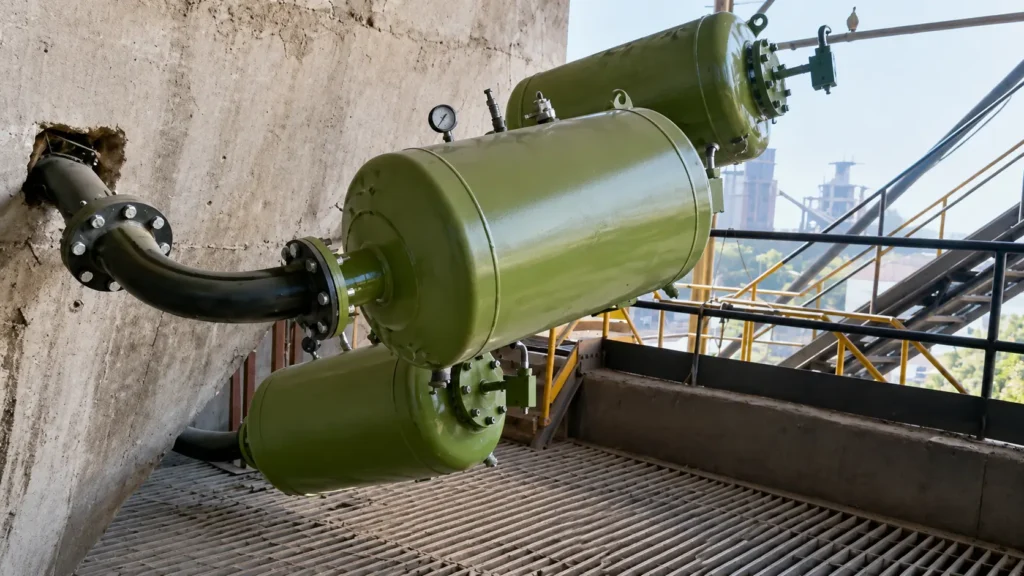
The concept sounds simple. The engineering behind it is not. The effectiveness of an air blaster system depends entirely on proper sizing (air volume vs. vessel geometry), nozzle placement, firing sequence, and control logic. A poorly designed system does almost nothing. A well-designed one can eliminate manual blockage clearing almost entirely.
How a Properly Designed Air Blaster System Works
Think of it as a coordinated percussion orchestra inside your silo. Multiple air blasters are mounted at strategic points — typically at the cone, walls, and transition zones of the vessel. A digital sequential control timer fires them in a specific sequence, so that pulses travel through the material in a wave pattern that dislodges blockages systematically rather than randomly hammering the same spot.
The key components in a complete system include:
- Air Blaster / Air Cannon — the main pressure vessel and valve assembly that delivers the pulse
- Nozzle — the interface between the blaster and the storage vessel; nozzle geometry determines pulse direction and dispersion
- Nozzle Tips — replaceable wear components that protect the nozzle and can be customised for material type
- Air Receiver Tank — stores compressed air for multiple blasters, ensuring consistent pressure during sequential firing
- Pneumatic Control Panel — manages air supply, pressure regulation, and system safety
- MS Bend Pipes — route the air pulse from the blaster to the vessel at the correct angle, especially in difficult vessel geometries
- Digital Sequential Control Timer — the brain of the system; controls firing order, timing, and frequency
Together, these components create a system that runs autonomously, 24 hours a day, preventing blockages before they become emergencies. The better manufacturers — and there aren’t many truly experienced ones — design the entire system as an integrated solution rather than selling you individual parts.
Which Industries Need This the Most?
Honest answer: any industry that moves bulk solids at scale. But some sectors have more acute problems than others, and the solutions look slightly different in each one.
⚙️ Cement Plants
Preheaters, cyclones, raw meal silos, and clinker storage are all blockage hotspots. High temperatures and fine particle sizes make cement one of the most challenging material flow environments. Air blasters in cement plants have arguably the fastest payback period of any industry.
⚡ Power Plants
Coal bunkers, fly ash silos, and bottom ash hoppers all require reliable flow to maintain boiler efficiency. A blocked coal feeder means a boiler running at partial load — which in a power plant, costs real money every minute.
⛏️ Coal Mines & Processing
Coal naturally bridges and rats because of its irregular particle size and variable moisture. Chutes, surge bins, and transfer points are especially vulnerable. Air cannons in coal mine reduce the dangerous manual clearing that puts workers at risk inside vessels.
🏗️ Steel Plants
Iron ore, DRI pellets, flux, and coke all have different flow characteristics — and most steel plants handle all of them. Sinter plant hoppers and blast furnace feed systems are where air blasters add the most value here.
🌿 Sugar Mills
Sugar is hygroscopic — it absorbs moisture and clumps aggressively, especially in warm, humid Indian conditions. Hoppers and conveyors in sugar mills without air blasters require constant manual intervention during peak crushing season.
🧪 Petrochemicals & Pharma
These industries need food-grade or explosion-proof blaster configurations. The stakes are higher — blockages here can affect product quality and compliance, not just production volume. Specialized nozzle materials and certifications matter.
🌡️ Heat Recovery Systems
HRSG systems accumulate dust and particulates in hoppers that must be cleared without interrupting the heat recovery cycle. Continuous operation requirements make autonomous air blasting critical here.
🧱 Sponge Iron (DRI) Plants
Sponge iron has high surface area and irregular shape — it bridges very easily. Rotary kilns, coolers, and product hoppers all benefit from well-placed air blaster installations. Several Indian DRI plants have reported 30–50% reduction in kiln stoppages after installation.
How to Choose the Right Air Blaster System — Don’t Get Sold on Specs Alone
This is where most buyers make mistakes. They compare tank volumes and pressure ratings, pick the highest numbers, and wonder why the system doesn’t perform. Air blasters are application-specific. What works brilliantly in a cement cyclone will be completely wrong for a sugar hopper.
Here’s what actually matters when specifying a system:
- Vessel geometry— size, shape, cone angle, and outlet dimensions determines how many blasters you need and where to place them
- Material characteristics— particle size, bulk density, moisture content, and temperature sensitivity all affect nozzle selection and pulse duration
- Operating pressure of your compressed air supply— blasters need consistent inlet pressure; an undersized air receiver will cause inconsistent performance
- Firing sequence logic— a random timer is far less effective than a properly sequenced system designed around the vessel’s flow geometry
- Nozzle material and configuration— high-temperature applications, abrasive materials, and explosion-risk environments each need specific nozzle specifications
- After-sales support and spare parts availability— a system with no local support is a liability, not an asset
The right manufacturer won’t just sell you blasters. They’ll do a site assessment, map your problem zones, design the firing sequence, and stand behind the installation. That’s the difference between a product purchase and a solution.
Manufacturer Spotlight
Ubon India — ISO 9001:2015 Certified Air Blaster Systems Since 2018
Based in Faridabad, Haryana, Ubon India has been manufacturing and supplying air blaster systems — along with the complete range of nozzles, air receivers, pneumatic control panels, MS bend pipes, nozzle tips, purging systems, and digital sequential timers — since 2018. They’re ISO 9001:2015 certified, which means their manufacturing and service processes are audited for consistency, traceability, and customer satisfaction.
What makes them worth mentioning isn’t just the product range — it’s the end-to-end approach. From initial site analysis and system design through manufacturing, on-site installation, commissioning, and 24×7 after-sales support, their team handles the complete material flow solution. Their engineers have hands-on experience across cement plants, steel plants, coal mines, power plants, sugar mills, sponge iron facilities, and more.
Their product lineup covers every component in a complete system:
Air Blasters / Air Cannons, Industrial Nozzles, Nozzle Tips, Air Receiver Tanks, Pneumatic Control Panels, Air Blaster M.S Bend, Digital Sequential Control Timers, Purging Systems, Spare Parts.
If you’re evaluating options for a new installation or looking to upgrade an underperforming system, Ubon India offers free consultations and site-specific design support.
Maintenance Practices That Keep Air Blaster Systems Running at Peak Performance
An air blaster system that isn’t maintained will fail — quietly at first, then spectacularly. The good news is that maintenance is straight forward when done on a schedule. Here’s what matters:
Monthly Checks
- Inspect all nozzle tips for wear and erosion — replace before they reach 50% wall thickness loss
- Check compressed air moisture — wet air causes valve corrosion and inconsistent firing; your dryer and separator need regular attention
- Verify firing sequence on the control timer — confirm each blaster fires on schedule and in the correct order
- Listen for air leaks at all connection points during a scheduled test cycle
Quarterly Checks
- Inspect valve internals for corrosion, especially in humid or coastal environments
- Verify air receiver tank pressure holding — a tank that bleeds pressure between firing cycles indicates a valve or seal issue
- Inspect MS bend connections for fatigue cracks, particularly in high-vibration environments
- Review firing logs (if your control system supports it) to identify blasters that are firing more frequently — this often indicates a developing blockage zone
Signs Your System Needs Professional Attention
- Blockages are recurring despite the system being “on” — likely a sequence design problem
- Individual blasters fire but produce no audible pulse inside the vessel — nozzle blockage or pipe disconnection
- System pressure takes longer than usual to recover between cycles — compressor or receiver issue
- Any blaster that fires but doesn’t reset — valve assembly fault, replace immediately
The Future of Material Flow: Where the Industry Is Heading
For decades, material flow problems management was reactive — you waited for a blockage, then cleared it. The shift happening now, in better-run plants, is toward predictive and automated flow management.
A few trends worth watching:
- IoT-integrated control systems — smart timers that adjust firing frequency based on real-time level sensors and material moisture data, not just fixed schedules
- Vibration and acoustic monitoring — embedding sensors in vessel walls to detect early-stage bridging and trigger blasters before a full blockage forms
- Variable-duration pulses — newer valve designs that can modulate pulse energy based on material conditions, reducing wear on vessel linings
- Centralised remote monitoring — SCADA-integrated air blaster systems that give plant managers visibility into every unit across the facility from a single dashboard
These aren’t science fiction. They’re in use at progressive plants today — mostly in Europe and gradually in India’s larger cement and steel groups. If you’re building or upgrading a facility now, it’s worth designing the electrical and control infrastructure to support this kind of integration, even if you’re not implementing it immediately.
Wrapping Up — The Bottom Line for Plant Managers
Material flow problems are one of those problems that rarely appear on a P&L statement as a line item — but it absolutely shows up in your overall equipment effectiveness (OEE), your overtime costs, your maintenance bills, and the useful life of your downstream equipment.
Air blaster systems are not new technology. But they remain underutilised across Indian heavy industry, largely because the upfront capital is visible and the savings are distributed across operations and maintenance budgets that rarely talk to each other. If you’ve read this far, you already understand that the calculation isn’t complicated. The question is just whether anyone has made the case clearly enough.
Start with an honest audit of your current flow problems. How many hours per month do your people spend manually clearing blockages? What does each production disruption cost you in lost throughput? How much are you spending on liner repairs caused by manual clearing? Put those numbers together, and the ROI of a proper air blaster system usually becomes obvious.
If you want a starting point, Ubon India offers free consultations and has the engineering experience to assess your specific application — not just sell you units off a shelf.
For More Relatable Content You can Visit Our Blog page.